

A person sees an ad while walking down the street, waiting for the bus, or driving to work. At that moment, they may not intend to buy anything and will probably go about their day without taking any action.
A few days later, they enter a store and encounter that brand again. This time, they recognize it. It seems familiar. They might even consider it over other options they don't know.
Many things have happened between those two moments, and outdoor advertising is just one of them. But an interesting question arises. To what extent can an outdoor ad influence a purchase decision?
The short answer is yes, it can influence, although that doesn't mean every ad we see ends up generating a sale. Its role is usually broader and can help a brand become known, remembered, and recognizable so that it has more chances of being considered when the time comes to choose.
Outdoor advertising encompasses the advertising messages we find outside our homes during our daily commutes and activities.
Within it, we find very different media, such as billboards, MUPIS, bus shelters, buses, large-format banners, street furniture, stations, airports, shopping malls, or digital screens.
Two terms are usually used to differentiate its main formats.
The difference is mainly technological, although both formats share something fundamental, as they appear in physical spaces where people move.
An outdoor campaign does not necessarily have to result in someone buying immediately after seeing an ad. It can work in various stages of the process.
An unknown brand can use outdoor advertising to make itself known. An established brand can resort to this medium to remain in memory. A restaurant can advertise near its establishment to attract visitors, and a consumer goods brand can remind people of its product a few minutes before they enter a supermarket.
Therefore, their objectives can be very different and range from achieving notoriety and increasing brand recall to facilitating recognition, reinforcing a campaign in other media, or bringing people closer to an establishment.
Outdoor advertising aims precisely at this combination of reach, repetition, familiarity, and physical context as one of the keys to understanding its operation.
It's not necessarily about someone seeing a billboard and thinking they're going to buy that product. Often the effect is simpler because the brand starts to become familiar to them.
People don't normally go out looking for ads; they encounter them while doing something else, like walking, driving, waiting for a train, entering a shopping mall, traveling, or shopping.
This differentiates outdoor advertising from a Google search, where there is a clear intention to find information. It also means that the available time to communicate is usually limited.
There is no single average attention span valid for all outdoor advertising. A billboard by the roadside is viewed in very different conditions than a screen in an airport or a display next to an escalator in a shopping mall.
Speed, distance, the angle from which the ad is viewed, and the time a person spends in the location directly influence the chances of them seeing it. Current outdoor measurement systems take many of these variables into account.
The consequence for design is quite clear, as the less time a person has to look at the ad, the simpler the message must be.
An identifiable brand, a clear image, and little text are usually more likely to be processed quickly than creative content full of information.
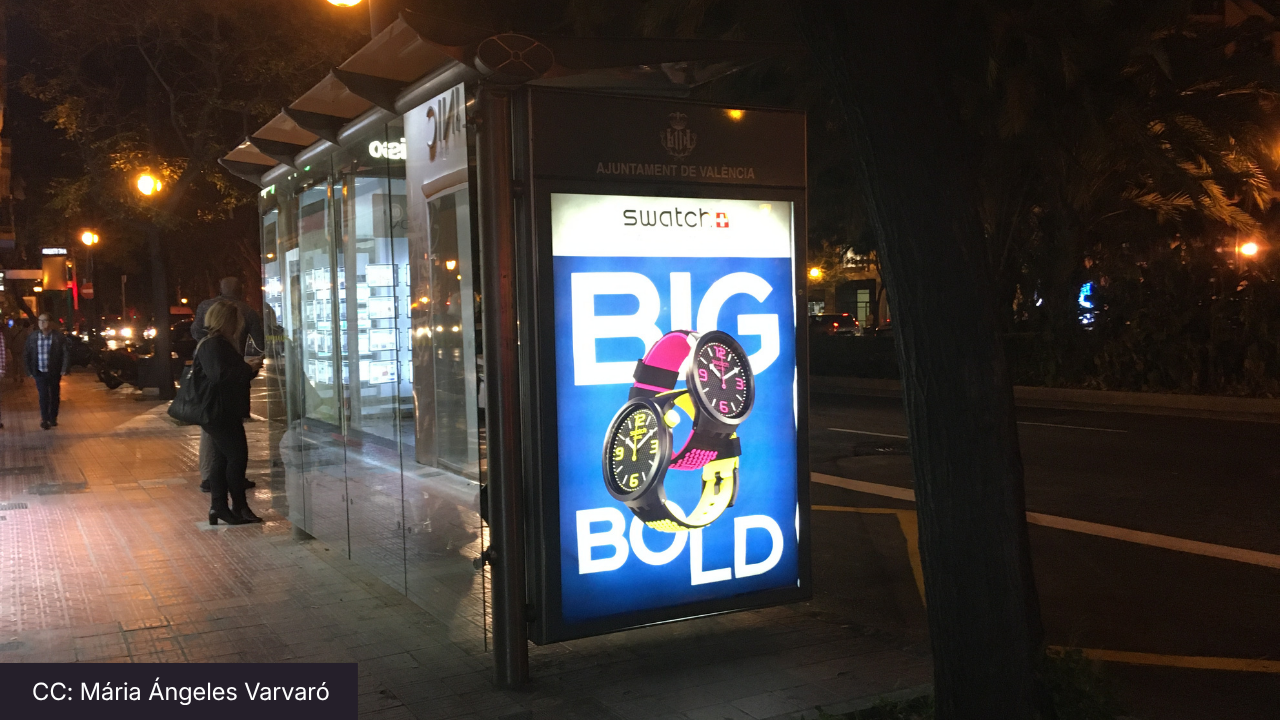
One of the most interesting effects of outdoor advertising appears when a person encounters a brand again. They may not remember exactly where they first saw it. Maybe it was on a bus shelter. Maybe at a station. Maybe they passed a billboard several times on their way to work.
However, when it later appears in a store, in a search, or on social media, it is no longer completely unfamiliar. This is where concepts such as brand recall, the recognition and the familiarity.
Psychological research on the so-called mere-exposure effect has shown that repeated exposure can modify our evaluation of something even if we do not perfectly remember each previous encounter. In consumer products, it has also been observed that familiarity and repetition interact in how we evaluate brands.
This does not mean that repeating an advertisement indefinitely guarantees better results. It means that a brand that appears consistently may be easier to recognize later.
There are normally several steps between seeing an advertisement and buying a product.
A reasonable journey might start with seeing the ad, continue with brand identification, and later, brand recognition or recall. Then may come consideration, comparison with other options, and finally, the choice. Any of these steps can be broken.
We might see a restaurant's campaign and not be hungry. We might also remember it a week later and discover it's too far away. Likewise, we might find a brand in a supermarket and prefer another because it's on sale.
Therefore, saying that an outdoor campaign 'caused a purchase' requires much more evidence than simply demonstrating that a person was exposed to the ad. However, there are situations where the connection between outdoor advertising and behavior is particularly visible.
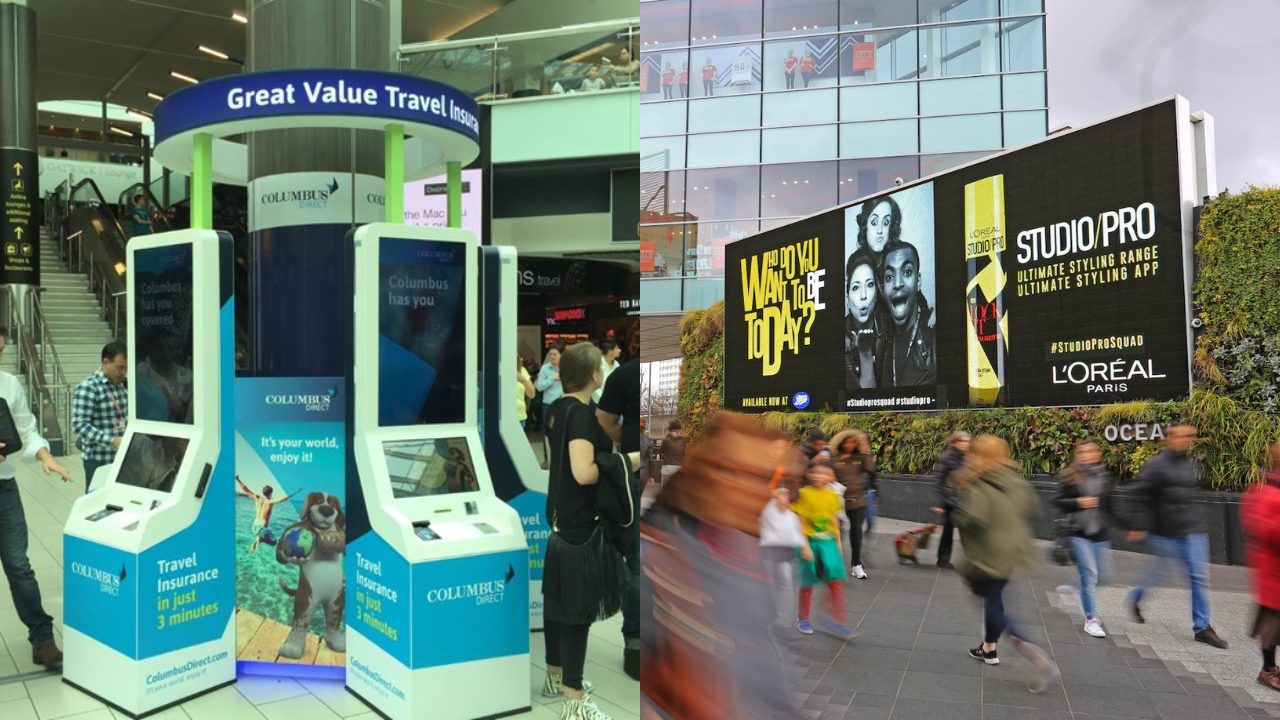
A good example is Columbus Direct. The company installed interactive kiosks at Gatwick Airport targeting travelers who had not yet purchased insurance. The context was especially favorable because the audience was about to travel, the product solved an immediate need, and the medium itself allowed for action.
According to the case study published by Outsmart, sales increased by 57% during the campaign. It is a particularly clear example of what happens when message, need, and purchase opportunity appear almost simultaneously. Even so, this is a commercial case and not a controlled experiment, so not all of the growth can be automatically attributed solely to the medium.
Another example is L’Oréal Paris Studio Pro at Westfield London. The brand combined digital out-of-home advertising and a product experience very close to a Boots store. The published case study reported a 325% increase in Studio Pro sales in that environment during the activation.
The figure is striking, but it also shows why these cases must be interpreted with care, since location, brand experience, product, establishment, and other elements besides DOOH were involved.
The distance between the ad and the place where the purchase can be made greatly changes its function.
In this way, both the time between the message and the action is reduced, as well as the effort necessary to take action.
Therefore, shopping centers, supermarkets, stations, parking lots, airports, and commercial areas have a particular value for certain campaigns.
The principle is simple. A food advertisement may have a greater capacity to generate a response if the restaurant is 200 meters away than if it is across town. Outdoor advertising does not necessarily create the need, but it can appear right when that need already exists.
Choosing a good location is not just about looking for the place with the most foot traffic.
A high-traffic medium may have thousands of exposure opportunities and still be ineffective if it is poorly positioned, hard to see, or the message takes too long to understand.
Among the influencing factors are the number of people passing by, the speed at which they move, the distance to the support, its size, lighting, possible obstacles, viewing angle, and the time spent in the area. Who passes by also matters.
Ten thousand people who fit a brand's target audience can be more interesting than a much larger flow unrelated to the product.
Academic research on outdoor advertising has for decades found relationships between location, position, amount of text, creative characteristics, and advertising recall. Subsequent eye-tracking studies have reinforced the idea that location and creativity work together.
That's why there is no perfect location for all campaigns. The best location depends on the objective.
The influence of exterior communication does not end when we arrive at the establishment. The storefront sign is, in many cases, the last exterior message a person receives before deciding whether to enter. Its primary function is evident and consists of identifying the establishment.
But it also has others. A good sign helps locate the business, makes it easier to recognize from a certain distance, conveys brand information, and continues communicating even when the premises are closed.
Signage also fulfills a practical function and helps with orientation. This can be especially important in hotels, gas stations, shopping malls, restaurants, or commercial estates, where finding an entrance, a reception, a parking lot, or a specific establishment is not always immediate.
Eye-tracking studies conducted in commercial environments have shown that signage participates in consumers' navigation and search processes. They have also shown that installing a sign does not guarantee it will be seen, so its design and location remain fundamental.
The Sign Research Foundation also collects studies according to which 36% of US consumers stated they had visited a new establishment due to the quality of its sign. This is an interesting piece of data for understanding its commercial function, although it comes from an organization linked to the signage sector itself and should be interpreted as industry evidence, not as a rule automatically applicable to any business.
Ultimately, a sign is not just for placing a name on a facade. It also makes an establishment findable and recognizable in physical space.
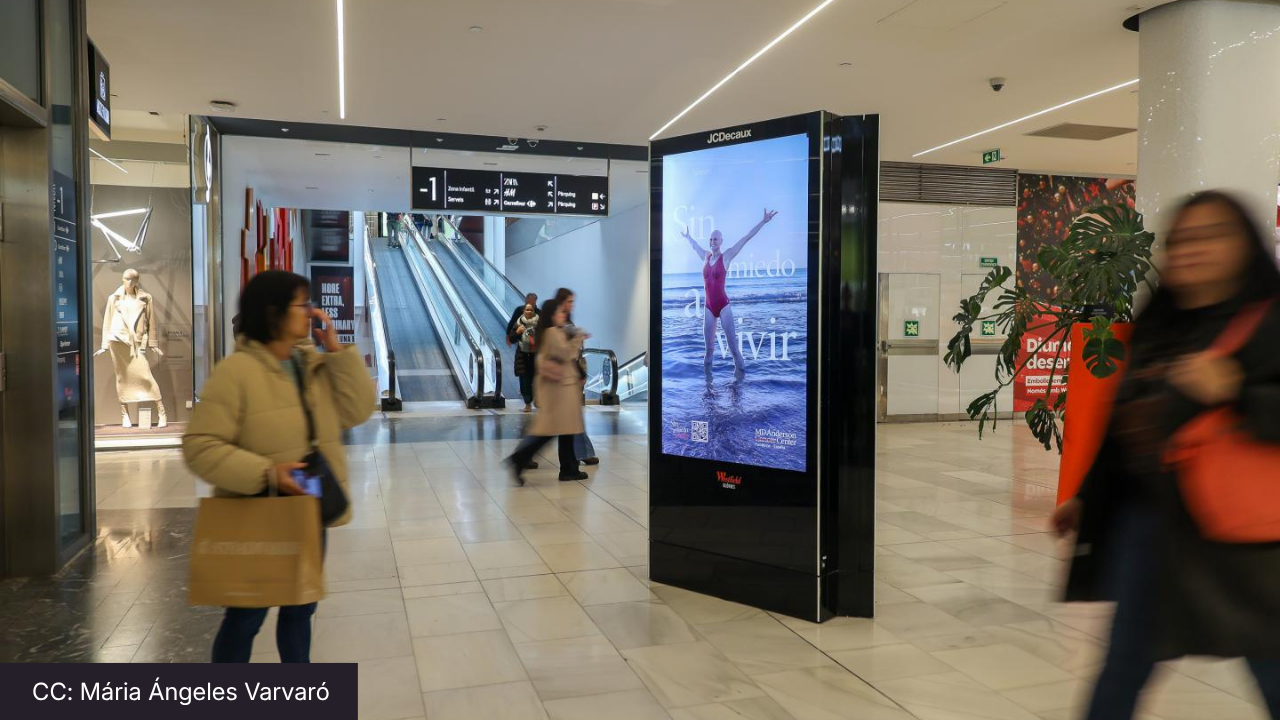
Outdoor advertising can influence a purchase decision, although its effect is not always immediate or easy to attribute to a single advertisement.
Its value often lies in making a brand known, recognizable, and familiar before the moment of choice arrives. When that brand reappears in a store, on a search engine, on a social network, or at the point of sale itself, part of the work is already done.
Location, repetition, message clarity, and proximity to the establishment can increase that influence. Elements like signage and wayfinding also contribute, helping to identify a business, find it, and reinforce its image just before entering.
Therefore, outdoor advertising works best when understood as another part of the consumer's journey. It usually does not act alone, but in conjunction with other channels, the product itself, the price, the shopping experience, and the context.
Ultimately, seeing an ad doesn't mean buying. But it can mean that, when the time comes to decide, a brand is better known, easier to remember, and more present among the consumer's options.